
Skip to content

(865) 276-7293Free foundation repair referral line, independent service. How it works

Tennessee Foundation Repair

Foundation Settlement Repair and Stabilization in Tennessee

When part of a house sinks lower than the rest, the job is to stop the movement first and level what can be leveled second. Here is how settlement repair and foundation stabilization work, and what is different about Tennessee ground.

Free referral anywhere in Tennessee — Call (865) 276-7293

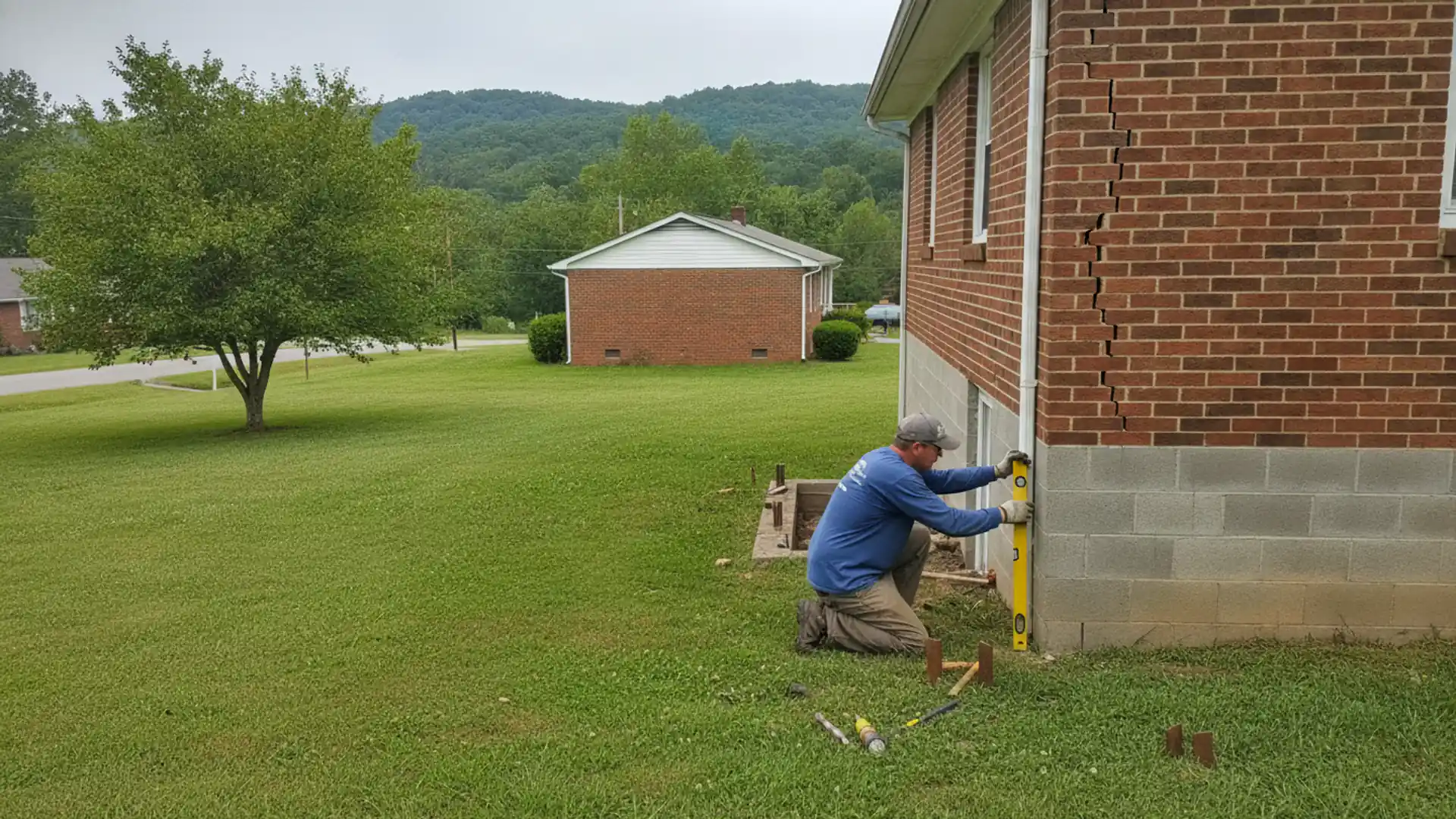
Corner of a brick home with a diagonal crack in the foundation where one section has settled lower

Free referral · No obligation

Get Help With a Settling Foundation

Call to be connected with a participating independent foundation repair contractor who serves your area. No obligation to hire.

Last updated: 2026-10-12

Tennessee Foundation Repair connects Tennessee homeowners with participating contractors for foundation settlement repair and stabilization. Settlement means some part of the foundation has moved down, usually because the soil under it compressed, washed out, or was never solid. Stabilization means stopping that movement, most often by transferring the load to something deeper and firmer.

Signs a foundation may be settling

These signs often show up together and on one side or corner of the house:

  • Diagonal cracks running up from the corners of doors and windows.
  • Stair-step cracks in block or brick.
  • Floors that slope toward one side or corner.
  • Doors that stick or swing open on their own; windows that will not close.
  • A chimney, porch, or addition pulling away from the house.
  • Gaps between the foundation and the siding, or at the top of interior walls.

Why Tennessee foundations settle

Settlement is a soil problem. The common causes are fill that was not compacted well, clay soil that shrinks in dry spells, soil softened or washed out by water, and, in much of Tennessee, karst. The USGS estimates about 43.5% of Tennessee sits on karst or rock that can form it, limestone and dolomite that dissolve slowly and leave voids and sinkholes. In the inner Central Basin, the USGS found about half the area falls in places where sinkholes cover at least 1% of the land; in the Valley and Ridge of East Tennessee the figure is about 38%.

Most settlement is slow. A sinkhole opening near the house is different: the Tennessee Emergency Management Agency says to move away from ground movement and call 911 if there is any immediate danger. Read more in what causes foundation settlement.

How foundation stabilization works

The standard fix for a settling section is underpinning with piers. Steel push piers are driven down with hydraulic equipment until they reach load-bearing soil or rock; helical piers are screwed in to a target torque. Brackets attach them to the footing, and the weight of the house is transferred to them. Some contractors can then lift the section back toward level, though not every house can or should be fully lifted, because lifting can open new cracks in finishes. See foundation piers for the comparison.

Other approaches fit other situations: mudjacking or polyurethane foam under a settled slab, compaction grouting in some soils, and drainage work to stop the soil from getting worse. Where a sinkhole is involved, the repair may need a geotechnical engineer to look at what is under the ground before anything is installed.

Sinkholes and insurance in Tennessee

Tennessee law (T.C.A. § 56-7-130) requires every insurer that sells homeowners insurance in the state to make sinkhole loss coverage available. It is optional, it can cost extra, and the Tennessee Department of Commerce and Insurance says insurers cannot limit it to the start of a policy. Standard policies commonly exclude settling and earth movement, so check what yours covers before you need it, and talk to your agent and insurer before repairs start if you plan to file a claim.

When to get a settling foundation evaluated

  • Cracks are new, growing, or wider at one end.
  • Floors slope enough to notice, or more than they used to.
  • Several doors or windows started sticking at once.
  • A porch, chimney, or addition is separating from the house.
  • A depression or sinkhole has appeared in the yard near the foundation.
  • You are buying or selling and the inspection mentions settlement.

What settlement repair costs

HomeAdvisor's June 2026 data puts a settling or sinking foundation at $5,000 to $25,000. Piers run $1,000 to $3,000 each, and the number of piers depends on how much of the foundation is affected. Mudjacking a settled slab runs $500 to $1,300. A structural engineer inspection runs $340 to $780 and is often worth it on a job this size.

  • How much of the foundation is settling: one corner or a whole side.
  • Pier type and depth: the distance to load-bearing material varies across Tennessee.
  • Whether lifting is attempted.
  • Sinkhole or void work: geotechnical study and grouting add cost.
  • Finish repairs afterward (drywall, trim, doors) are often not included.
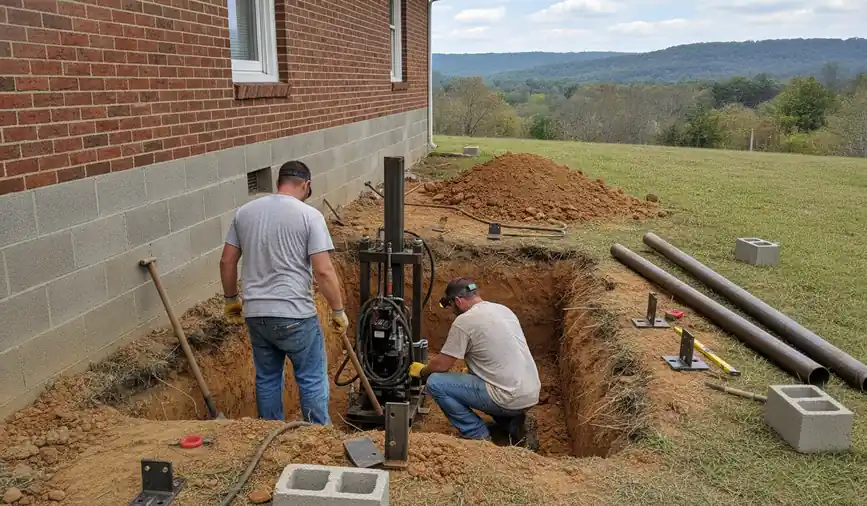
Hydraulic pier driving equipment set up beside an excavated section of house foundation

What you can do right now

  1. Photograph and date cracks and gaps so changes are easy to see.
  2. Make sure downspouts discharge well away from the house and the ground slopes away.
  3. Check your homeowners policy for settling, earth movement, and sinkhole coverage.
  4. If a sinkhole opens or anything is actively moving, keep everyone away and call 911.
  5. Call and describe where the house is moving; ask whether an engineer should look first.

Questions to ask about settlement repair

  • What do you think is under the settling section: fill, clay, washed-out soil, or a void?
  • Push piers or helical piers, how many, how deep, and why?
  • Will you try to lift the house, and what could crack if you do?
  • Should a structural or geotechnical engineer look at this first?
  • Is the warranty on the piers, the lift, or both, and does it transfer?

Related foundation repair guides

Straight answers

What you can do vs. when to get a professional evaluation

Watching, measuring, and fixing drainage are things a homeowner can do. Diagnosing the cause and repairing structure are not.

What you are seeingWhat you can do nowWhen to get a professional evaluation
A thin vertical crack in a poured concrete wallPhotograph it with a ruler or coin for scale and date the photo; check it again after a few months and after heavy rainIt widens, one side sits higher than the other, or water comes through
Stair-step cracks in block or brickPhotograph and date them; note any doors or windows nearby that stickThe cracks are getting longer or wider, or bricks or blocks have shifted out of line
A basement wall leaning or bowing inwardKeep the area clear and dry; do not try to push or brace it yourselfAlways: horizontal cracks and inward bowing are a structural question
Sloping or bouncy floors over a crawl spaceLook (safely) for standing water or wet wood; note where the floor dipsFloors are getting worse, posts or beams look damaged, or wood is soft or rotted
Doors and windows suddenly stickingNote which ones and when; seasonal humidity can do this tooSeveral stick at once, with new cracks above the frames
A depression or hole opening near the houseKeep people and pets away; on public land or a road, report it to local officialsAlways, and call 911 if a building is moving or there is any immediate danger (TEMA)

General guidance, not a diagnosis. Safety steps follow the Tennessee Emergency Management Agency'sgeological hazards guidance. Never jack, cut, or remove a structural support yourself.

What to expect

What settlement repair usually involves

Every house and every foundation problem is different. These are the stages most foundation repair projects follow.

  1. An on-site evaluation

    A foundation repair contractor looks at the cracks, floors, doors, walls, crawl space or basement, and the drainage around the house, and may measure how level the floors are. Symptoms alone do not tell anyone the cause; the visit is where that starts.

  2. A written repair plan and price

    Ask for the proposed repair, why it fits the cause they found, how many piers or supports and where, any permit, and the price in writing before work starts. In Tennessee, jobs of $25,000 or more need a state contractor license.

  3. An engineer, when the situation calls for one

    For major movement, a sinkhole near the house, a home sale, or two contractors who disagree, an independent licensed structural engineer can assess the cause and specify the repair. Contractors are not engineers unless they say so and are licensed as one.

  4. The repair

    Depending on the cause, that can mean piers or underpinning, wall anchors or braces, crack injection, added crawl space supports, or drainage changes. Ask how long it will take and what access is needed.

  5. Warranty and paperwork

    Get the warranty in writing: what it covers, for how long, and whether it transfers to a buyer. Keep the plan, invoices, permit, and any engineer report together; buyers and inspectors ask for them.

How the referral works

How our contractor-matching service works

  1. You call the number on this site

    Have the property address or ZIP code ready, plus what you are seeing: cracks, sloping floors, sticking doors, a bowing wall, and how long it has been going on.

  2. Your call is routed to a participating contractor

    Your call is connected with a participating independent foundation repair contractor who serves your area, if one is available. We do not inspect or send anyone ourselves.

  3. You deal with that contractor directly

    The contractor evaluates the house, recommends a repair, quotes the price, and does any work you agree to under their own business name, license, insurance, and warranty. You decide whether to hire them; there is no obligation.

Good to know: availability and eligible services depend on which participating contractors cover your ZIP code. Whoever you hire, ask for their Tennessee license number (if the job needs one) and check it with the state's license verification search. Our hiring questions cover the rest.

Get Help With a Settling Foundation

Call and we will try to connect you with a participating independent foundation repair contractor who serves your area.

Questions

Foundation Settlement Repair and Stabilization questions

What is the difference between foundation settlement repair and foundation stabilization?

In practice they describe the same job. Stabilization stops a foundation from moving further, usually with piers. Settlement repair includes that and, where possible, lifting the settled section back toward level.

How much does it cost to fix a settling foundation?

HomeAdvisor's June 2026 data puts a settling or sinking foundation at $5,000 to $25,000, with piers at $1,000 to $3,000 each. The total depends on how much of the foundation is affected and how deep the piers must go.

Does homeowners insurance cover a sinkhole in Tennessee?

Only if you have sinkhole coverage. Tennessee requires insurers to offer it, but it is optional and usually costs extra. Standard policies often exclude settling and earth movement. Check your policy and ask your agent.

Can a settled house be lifted back to level?

Sometimes partly. Many contractors can lift a section during pier installation, but full leveling is not always possible or wise because it can crack finishes and pipes. Ask what they expect to achieve and get it in writing.

Do I need a structural engineer or a foundation repair contractor?

Sometimes both. A contractor evaluates the house and proposes the repair they install. An independent licensed structural engineer assesses the cause and can specify a repair without selling one; HomeAdvisor puts a structural engineer inspection at $340 to $780. An engineer is worth it for major movement, a sinkhole near the house, a home sale, or contractors who disagree.

Call (865) 276-7293 · Foundation Repair Help