
Decision Guide
Ask what is causing the problem and how they know, exactly what they will install and where, whether the job needs a permit or an engineer, and what the written warranty covers. In Tennessee, also ask for the license number: jobs of $25,000 or more need a state contractor license, and in nine counties jobs from $3,000 to $24,999 need a Home Improvement license.
Published 2026-10-12 · Updated 2026-10-12
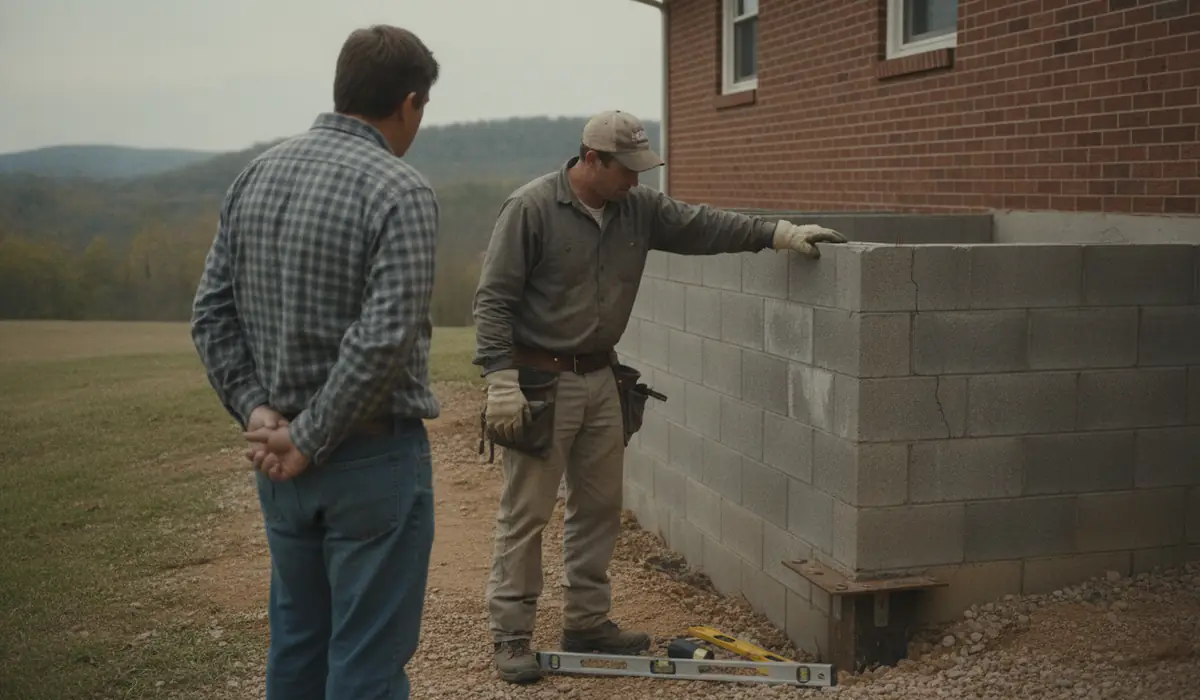
Foundation repair is a big check to write for work that ends up buried or hidden behind a wall. You can’t inspect a pier after it is installed, so the questions you ask beforehand matter more than in most trades. Here is what to ask, and why.
1. “What do you think is causing this, and how did you determine that?”
A good answer names a cause (settling fill, a wet corner, soil pressure on a wall, failing crawl space supports) and explains the evidence: crack patterns, floor measurements, drainage, what is under the house. Be wary of a proposal that jumps straight to a product without explaining the cause.
2. “Exactly what will you install, how many, and where?”
Ask for a drawing showing every pier, anchor, brace, or support. For piers, ask about the type (push or helical), the rated capacity, and the spacing. If one proposal calls for 6 piers and another for 18 on the same wall, someone needs to explain why.
3. “Are you licensed for a job this size in this county?”
Tennessee licensing depends on the job size and the county:
- $25,000 or more: a state contractor license from the Tennessee Board for Licensing Contractors is required before bidding or negotiating the price.
- $3,000 to $24,999, residential: a state Home Improvement license is required, but only in the nine counties that adopted it: Bradley, Davidson, Hamilton, Haywood, Knox, Marion, Robertson, Rutherford, and Shelby. That includes Knoxville, Chattanooga, Nashville, and Murfreesboro, but not Johnson City or Kingsport.
- Under $3,000: no state license required.
Get the license number and check it at verify.tn.gov. For contractor licenses, the board sets a monetary limit; the job should fall within it.
4. “Do I need a structural engineer?”
A contractor sells and installs repairs; a licensed structural engineer assesses the cause and can specify the repair with nothing to sell. HomeAdvisor’s June 2026 data puts a structural engineer inspection at $340 to $780. It is often worth it when movement is significant, a sinkhole is near the house, you are buying or selling, or contractors disagree. Ask whether the contractor works with an engineer and whether you receive the engineer’s report.
5. “Does this need a permit, and who pulls it?”
Permit rules vary by city. Kingsport’s building division, for example, says permits are needed for renovations other than cosmetic repairs. Ask the contractor to confirm with the local building office and to pull any permit in their name.
6. “Will you lift the house, and what might crack?”
Lifting a settled section can open new cracks in drywall, tile, and trim, and can affect plumbing. Ask what level they expect to reach, how they will measure it, and whether cosmetic repairs afterward are included.
7. “What does the warranty cover, and does it transfer?”
Get the warranty in writing. Ask whether it covers the piers or supports, further settlement of the repaired section, the lift, or only the products; how long it lasts; who honors it if the company closes; and whether it transfers to a buyer, and for what fee. “Lifetime” means little without the fine print.
8. “What insurance do you carry?”
Ask for a certificate of liability insurance and, if they have employees, proof of workers’ compensation. Tennessee’s Home Improvement license requires proof of general liability and workers’ compensation insurance and a $10,000 surety bond or other financial guarantee.
9. “What is not included?”
Common exclusions: drainage work, landscaping and concrete replacement, interior finish repairs, plumbing tests, permits, and engineering. Two proposals that look $3,000 apart may be the same price once exclusions are counted.
Red flags
- Pressure to sign the same day, or a “today only” discount.
- No explanation of the cause.
- No written scope, drawing, or warranty.
- Large cash deposits before any work or materials.
- Claims that every crack is an emergency, or that no crack ever matters.
For typical prices, see the Tennessee foundation repair cost guide.
The bottom line
If you want a professional to take a look, call (865) 276-7293 and we'll try to connect you with a participating independent foundation repair contractor who serves your area. That contractor evaluates and quotes the job themselves. In the meantime, don't jack, cut, or remove any structural support, and if the ground or the house is actively moving, get everyone out and call 911.