
Skip to content

(865) 276-7293Free foundation repair referral line, independent service. How it works

Tennessee Foundation Repair

Foundation Repair Services in Tennessee

Cracks, sloping floors, sticking doors, or a wall that has moved. Here is what foundation repair services involve, which repair fits which problem, and what the work typically costs.

Free referral anywhere in Tennessee — Call (865) 276-7293

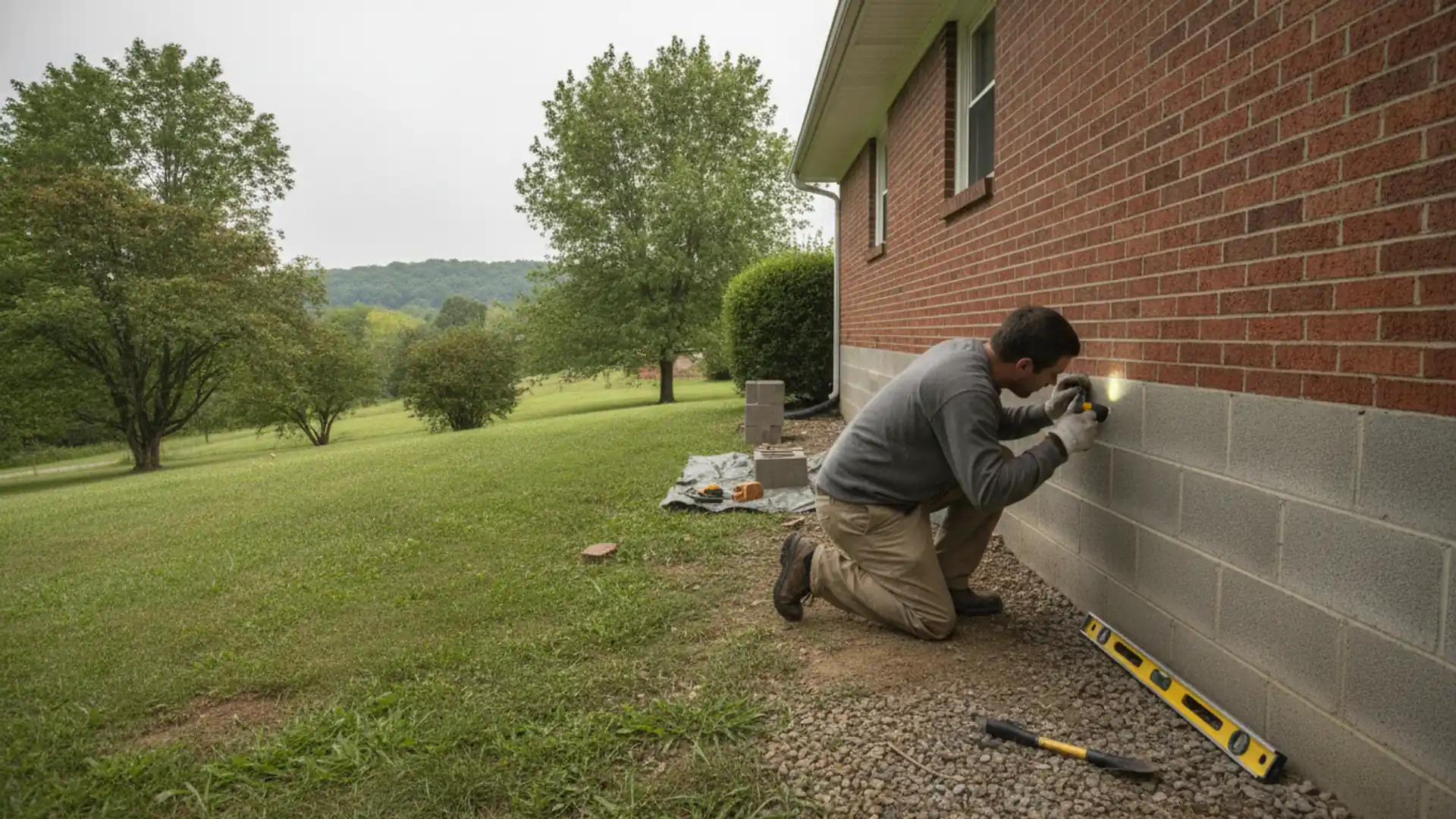
Foundation repair contractor examining the block foundation of a brick ranch home in Tennessee

Free referral · No obligation

Call for Foundation Repair Help

Call to be connected with a participating independent foundation repair contractor who serves your area. No obligation to hire.

Last updated: 2026-10-12

Tennessee Foundation Repair is an independent referral service that connects Tennessee homeowners, landlords, and buyers and sellers with participating contractors for foundation repair services. This page is the overview: the signs that send people looking, what tends to cause them in Tennessee, and the main repair methods side by side, so you can follow what a contractor proposes.

Common signs of a foundation problem

Most people call about something they can see or feel. None of these signs proves a structural problem on its own, but several together, or one that is getting worse, is worth an evaluation:

  • Cracks in basement or crawl space walls, especially horizontal cracks, stair-step cracks in block or brick, or cracks wider at one end.
  • Sloping, sagging, or bouncy floors, often over a crawl space.
  • Doors and windows that stick or no longer latch, with new cracks running from their corners.
  • Gaps between walls and ceilings, around window frames, or where a chimney or porch meets the house.
  • A basement wall that bows or leans inward.
  • Water coming through cracks, or soil washing away from the foundation.

What causes foundation movement in Tennessee

Foundations move when the soil under or beside them changes. In Tennessee, the usual suspects are water and what is under the soil. About 43.5% of the state sits on karst, limestone and dolomite that slowly dissolve and can form sinkholes, according to the U.S. Geological Survey. Clay soils also swell when wet and shrink when dry, and poorly compacted fill under newer houses can settle for years.

Water ties these together. Roof runoff dumped at the foundation, ground that slopes toward the house, and leaking pipes all soften soil, wash out fill, and can open sinkholes in karst. See what causes foundation settlement for the detail.

The main foundation repair methods

A good contractor chooses the repair from the cause, not the symptom. These are the methods you are most likely to see in a proposal:

  • Piers and underpinning: steel push piers or helical piers carry a settling section down to stable soil or rock. Foundation piers
  • Settlement repair and stabilization: stopping movement and, where possible, lifting the house back toward level. Settlement repair
  • Wall reinforcement: anchors, steel braces, or carbon fiber straps for bowing basement walls. Bowing wall repair
  • Crack repair: epoxy or polyurethane injection for poured walls; repointing or rebuilding for block and brick. Crack repair
  • Crawl space supports: new posts, beams, and joist repair under sagging floors. Crawl space structural repair
  • Slab lifting: mudjacking or polyurethane foam under settled concrete slabs and steps.
  • Drainage corrections: gutters, extensions, grading, and drains, often part of the fix and sometimes the whole fix for minor problems.

What decides which repair you need

Two houses with the same crack can need different repairs. Contractors weigh the foundation type (poured wall, block, slab, or pier and beam), how much and how fast it is moving, the soil and how deep good bearing material is, the drainage, and access. Depth matters in Tennessee: USGS well data puts the median depth to bedrock at about 2.4 meters (roughly 8 feet) in the inner Central Basin around Nashville and Murfreesboro, and about 12.8 meters (roughly 42 feet) in the Valley and Ridge around Knoxville, the Tri-Cities, and Chattanooga. That changes how far a pier has to go.

Ask every contractor to explain the cause they found and why their repair addresses it. If two contractors propose very different repairs, an independent structural engineer can settle it.

Foundation repair vs. foundation replacement

Replacement, lifting the house and pouring a new foundation, is rare and expensive. Most foundations can be stabilized and repaired in place. Replacement comes up when a foundation has failed across most of its length, is badly deteriorated, or is being rebuilt as part of a larger renovation, and it is a decision for a structural engineer.

When a professional assessment makes sense

  • A crack is getting wider or longer, or one side sits higher than the other.
  • Several doors or windows started sticking at about the same time.
  • Floors are noticeably sloped, or getting worse.
  • A basement wall has a horizontal crack or is leaning inward.
  • You are buying or selling a house and an inspector flagged the foundation.
  • A depression or sinkhole has opened near the house (if anything is moving, get people out first and call 911).

What foundation repair costs

HomeAdvisor's June 2026 data puts the average foundation repair at $5,174, with most homeowners spending $2,225 to $8,133, and a full range of about $500 to $16,000. By repair type it lists crack repair at $250 to $800, piers at $1,000 to $3,000 each, mudjacking at $500 to $1,300, bowing walls at $4,000 to $12,000, and a settling or sinking foundation at $5,000 to $25,000. These are national figures, not Tennessee quotes. See the Tennessee cost guide or the cost range calculator.

  • The cause and the method: sealing a crack costs a fraction of piering a wall.
  • How many piers or supports: priced per unit, so the length of the affected wall matters.
  • Depth to load-bearing soil or rock: deeper piers cost more.
  • Access: tight crawl spaces, finished basements, decks, and landscaping add labor.
  • Engineering, permits, and drainage: often separate line items.
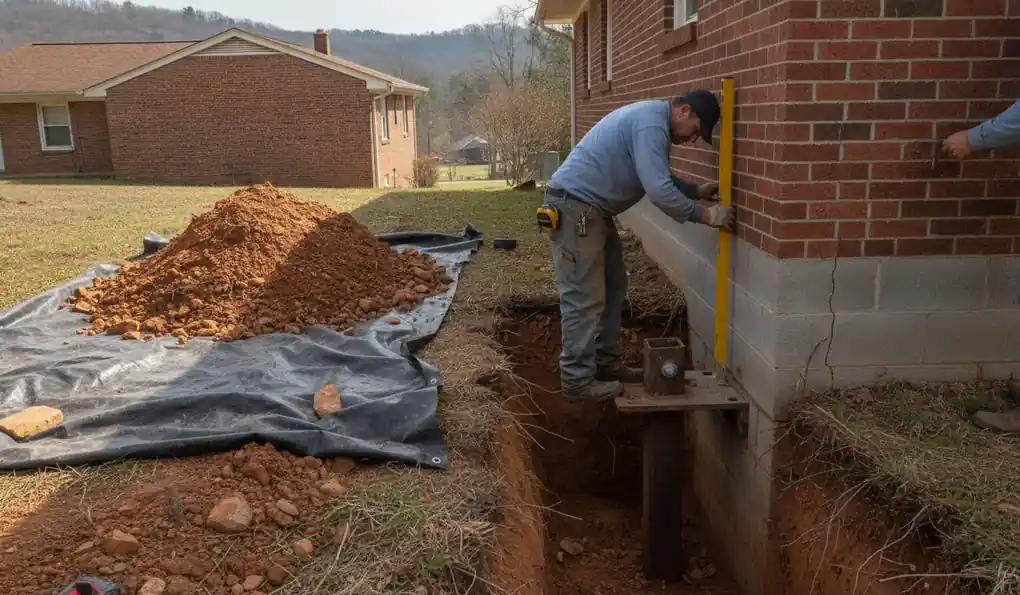
Steel foundation pier bracket installed against a concrete footing in an excavated trench beside a house

What you can do right now

  1. Photograph cracks with a ruler or coin for scale and write the date on the photo.
  2. Make a list: which doors stick, where floors slope, when you first noticed.
  3. Clear gutters and point downspouts at least several feet away from the house.
  4. Do not jack, shim, or remove any structural support yourself.
  5. Call and describe what you are seeing; ask what the contractor would look at first.

Questions to ask a foundation repair contractor

  • What do you think is causing the movement, and how did you determine that?
  • What exactly will you install, how many, and where? Can I see it on a drawing?
  • Will the job need a permit or an engineer? Who arranges and pays for them?
  • Is your business licensed in Tennessee for a job this size, and what is the license number?
  • What does the written warranty cover, for how long, and does it transfer if I sell?

Related foundation repair guides

Straight answers

What you can do vs. when to get a professional evaluation

Watching, measuring, and fixing drainage are things a homeowner can do. Diagnosing the cause and repairing structure are not.

What you are seeingWhat you can do nowWhen to get a professional evaluation
A thin vertical crack in a poured concrete wallPhotograph it with a ruler or coin for scale and date the photo; check it again after a few months and after heavy rainIt widens, one side sits higher than the other, or water comes through
Stair-step cracks in block or brickPhotograph and date them; note any doors or windows nearby that stickThe cracks are getting longer or wider, or bricks or blocks have shifted out of line
A basement wall leaning or bowing inwardKeep the area clear and dry; do not try to push or brace it yourselfAlways: horizontal cracks and inward bowing are a structural question
Sloping or bouncy floors over a crawl spaceLook (safely) for standing water or wet wood; note where the floor dipsFloors are getting worse, posts or beams look damaged, or wood is soft or rotted
Doors and windows suddenly stickingNote which ones and when; seasonal humidity can do this tooSeveral stick at once, with new cracks above the frames
A depression or hole opening near the houseKeep people and pets away; on public land or a road, report it to local officialsAlways, and call 911 if a building is moving or there is any immediate danger (TEMA)

General guidance, not a diagnosis. Safety steps follow the Tennessee Emergency Management Agency'sgeological hazards guidance. Never jack, cut, or remove a structural support yourself.

What to expect

What a foundation repair project usually involves

Every house and every foundation problem is different. These are the stages most foundation repair projects follow.

  1. An on-site evaluation

    A foundation repair contractor looks at the cracks, floors, doors, walls, crawl space or basement, and the drainage around the house, and may measure how level the floors are. Symptoms alone do not tell anyone the cause; the visit is where that starts.

  2. A written repair plan and price

    Ask for the proposed repair, why it fits the cause they found, how many piers or supports and where, any permit, and the price in writing before work starts. In Tennessee, jobs of $25,000 or more need a state contractor license.

  3. An engineer, when the situation calls for one

    For major movement, a sinkhole near the house, a home sale, or two contractors who disagree, an independent licensed structural engineer can assess the cause and specify the repair. Contractors are not engineers unless they say so and are licensed as one.

  4. The repair

    Depending on the cause, that can mean piers or underpinning, wall anchors or braces, crack injection, added crawl space supports, or drainage changes. Ask how long it will take and what access is needed.

  5. Warranty and paperwork

    Get the warranty in writing: what it covers, for how long, and whether it transfers to a buyer. Keep the plan, invoices, permit, and any engineer report together; buyers and inspectors ask for them.

How the referral works

How our contractor-matching service works

  1. You call the number on this site

    Have the property address or ZIP code ready, plus what you are seeing: cracks, sloping floors, sticking doors, a bowing wall, and how long it has been going on.

  2. Your call is routed to a participating contractor

    Your call is connected with a participating independent foundation repair contractor who serves your area, if one is available. We do not inspect or send anyone ourselves.

  3. You deal with that contractor directly

    The contractor evaluates the house, recommends a repair, quotes the price, and does any work you agree to under their own business name, license, insurance, and warranty. You decide whether to hire them; there is no obligation.

Good to know: availability and eligible services depend on which participating contractors cover your ZIP code. Whoever you hire, ask for their Tennessee license number (if the job needs one) and check it with the state's license verification search. Our hiring questions cover the rest.

Call for Foundation Repair Help

Call and we will try to connect you with a participating independent foundation repair contractor who serves your area.

Questions

Foundation Repair Services questions

How much does foundation repair cost in Tennessee?

HomeAdvisor's June 2026 national data puts the average at $5,174, with most projects between $2,225 and $8,133. Crack repair runs $250 to $800, piers $1,000 to $3,000 each, and a settling foundation $5,000 to $25,000. Tennessee prices depend on the house, the method, and the contractor.

Is foundation repair covered by homeowners insurance?

Often not. Many policies exclude settling, earth movement, and wear. Tennessee law requires insurers to offer sinkhole coverage, but it is optional and has to be added to the policy. Read your policy and ask your agent before assuming either way.

Does foundation repair really work?

It can, when the repair matches the cause. Piers can stop a settling section from sinking further, and anchors or braces can stop a wall from moving further. No method fixes a drainage problem that is left in place, and no honest contractor promises a house will never move again without a written warranty.

How long does foundation repair take?

Crack injection can be done in a day. Pier jobs on a typical house often take a few days, and bigger projects with excavation, permits, or engineering take longer. Ask the contractor for a schedule in writing.

Do I need a structural engineer or a foundation repair contractor?

Sometimes both. A contractor evaluates the house and proposes the repair they install. An independent licensed structural engineer assesses the cause and can specify a repair without selling one; HomeAdvisor puts a structural engineer inspection at $340 to $780. An engineer is worth it for major movement, a sinkhole near the house, a home sale, or contractors who disagree.

Call (865) 276-7293 · Foundation Repair Help