
Last updated: 2026-10-12
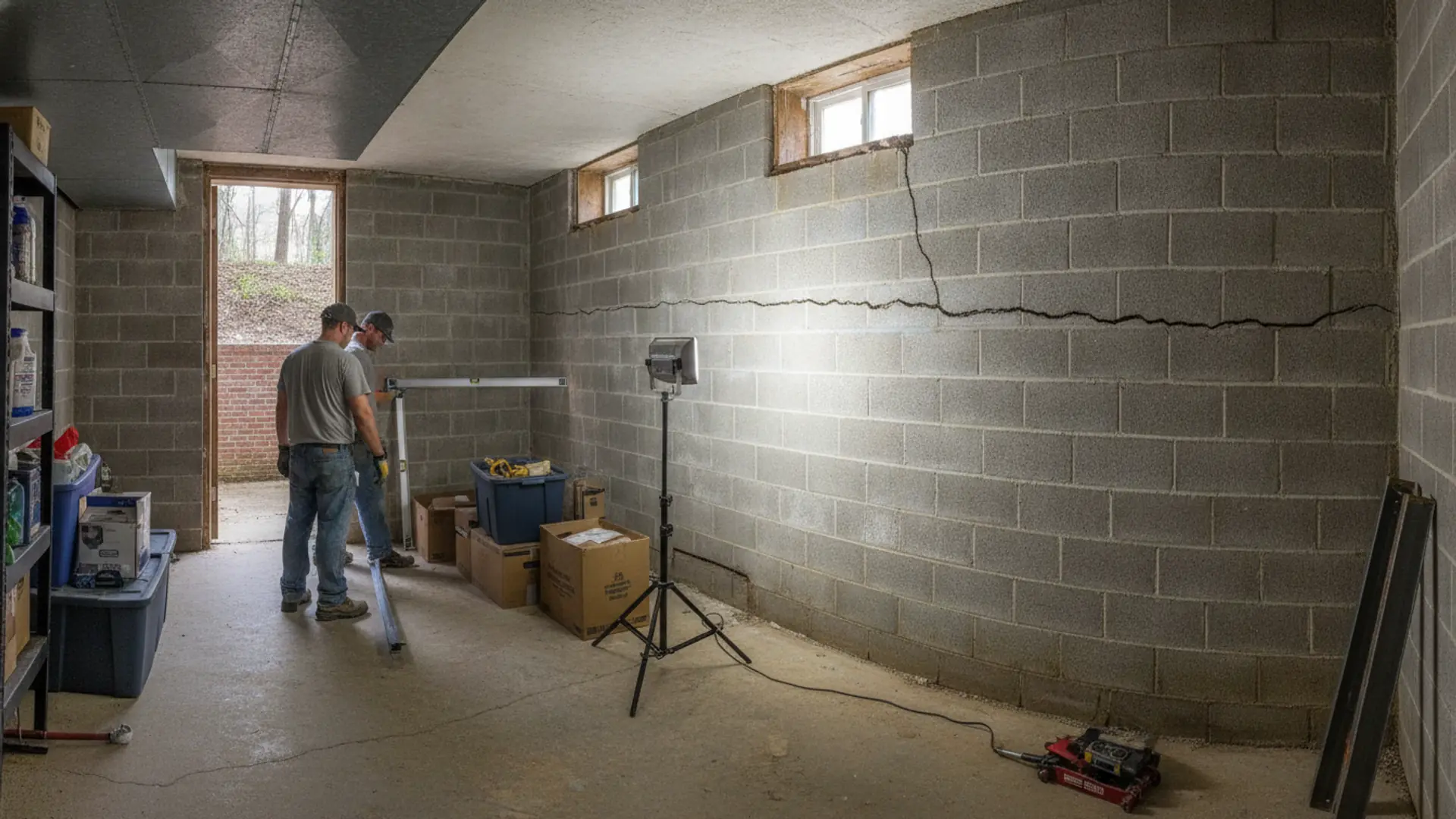
Tennessee Foundation Repair connects Tennessee homeowners with participating contractors for bowing basement wall repair. Basements are common on the hillsides and ridges of East and Middle Tennessee, and a basement wall is also a retaining wall: it holds back the soil around the house. When that soil gets heavy with water or swells, the pressure can push a wall inward, most often a concrete block wall along a horizontal mortar joint.
Signs of a bowing or leaning wall
Look along the wall from one end, the way you would sight down a board:
- A horizontal crack running along the wall, often about midway up or near the top.
- Stair-step cracks at the ends of the wall in block.
- The middle of the wall visibly bulging inward.
- The top of the wall leaning in past the bottom, or the bottom sliding in.
- Gaps between the top of the wall and the floor framing above.
- Water seeping through the cracks.
Why basement walls bow
Soil pressure. Wet soil weighs more than dry soil, and clay swells when it soaks up water. Downspouts that dump next to the house, ground that slopes toward it, and poor backfill all keep the soil against the wall saturated. Tennessee gets plenty of rain: NOAA records show about 44 inches a year in the Tri-Cities and 50 to 56 inches in Knoxville, Nashville, Chattanooga, and Murfreesboro. Houses cut into hillsides have more soil and more water pushing on the uphill wall.
Repair options compared
Which method fits depends on how far the wall has moved, what is outside it, and the wall material:
- Wall anchors: steel rods run through the wall to plates buried in the yard, then tightened. Need room outside the wall; can sometimes pull a wall back gradually.
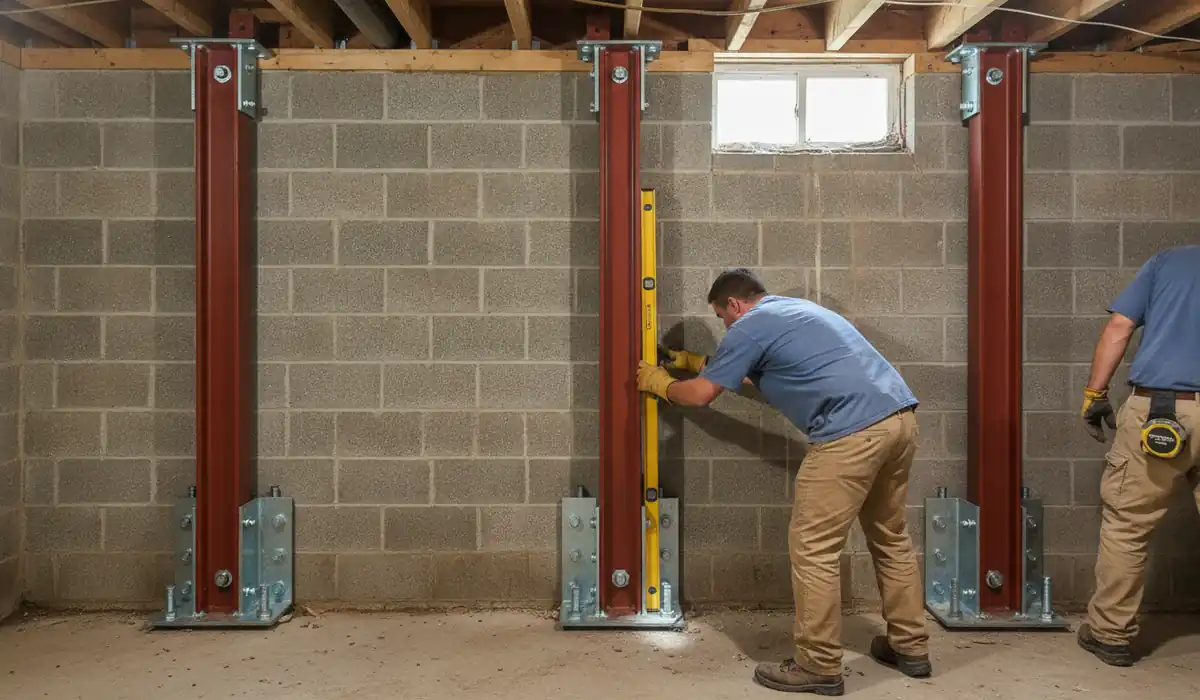
- Steel I-beam braces: vertical beams bolted to the floor and the framing above. Work where there is no room outside; take up some basement space.
- Carbon fiber straps: bonded to the wall to stop further movement. Low-profile; generally for walls that have not moved far.
- Excavation and rebuilding: digging out, straightening or rebuilding the wall, and backfilling with drainage. For walls that have moved too far for the other methods.
- Drainage: almost always part of a lasting fix.
Why this is not a wait-and-see problem
A small vertical crack can often be monitored. A wall that is bowing has already been moved by the soil, and the options narrow as it moves further. If a wall is moving quickly, the crack is widening, or the wall is separating from the framing above, keep people out of that part of the basement and get a professional evaluation promptly. Do not try to push, jack, or brace the wall yourself.
When to get a bowing wall evaluated
- You see a horizontal crack in a basement wall.
- The wall bulges or leans when you sight along it.
- Cracks are widening or new ones are appearing.
- The wall is pulling away from the floor framing above.
- Water comes through the wall after rain.
What bowing wall repair costs
HomeAdvisor's June 2026 data puts bowing wall repair with carbon fiber or steel reinforcement at $4,000 to $12,000. Contractors often price per anchor, brace, or strap, so the length of the wall and the spacing matter. Excavating and rebuilding a wall costs more. A structural engineer inspection runs $340 to $780.
- How far the wall has moved.
- Method: carbon fiber, braces, anchors, or rebuild.
- Wall length and number of supports.
- Outside access for anchors or excavation.
- Drainage work added to the job.
What you can do right now
- Photograph the wall from one end and the crack with a ruler, and date both.
- Move belongings away from the wall.
- Extend downspouts well away from that side of the house.
- Keep people out of the area if the wall is moving quickly.
- Call and describe the crack, the bow, and any water.
Questions to ask about bowing wall repair
- How far has the wall moved, and how did you measure it?
- Anchors, braces, carbon fiber, or a rebuild, and why?
- Will the wall be straightened or only stabilized where it is?
- What drainage work goes with the repair?
- Should a structural engineer review the wall first?