
Learn
Many foundation cracks are not serious. Thin vertical cracks in poured concrete are often shrinkage from curing. Cracks deserve a professional evaluation when they are horizontal, stair-stepped in block, wider than about a quarter inch, wider at one end, offset, growing, or paired with sticking doors and sloping floors. Only an on-site look can tell you the cause.
Published 2026-10-12 · Updated 2026-10-12
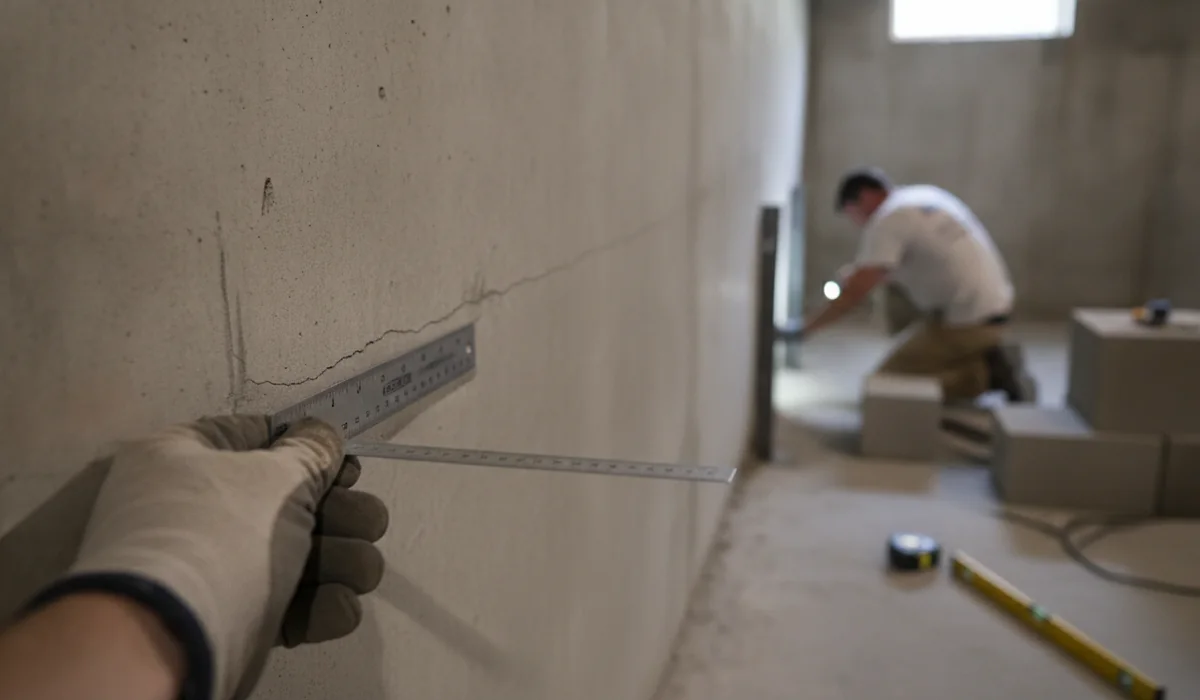
Finding a crack in the basement or crawl space wall is unsettling, and a lot of foundation marketing is built on that feeling. The honest answer is that some cracks are cosmetic and some are a sign of movement, and the crack alone rarely tells you which. Here is how to read the clues without panicking or ignoring a real problem.
Why concrete cracks at all
Concrete shrinks as it cures and dries, and it is weak when pulled apart. Small cracks in poured walls and slabs are so common that many builders treat them as normal. Block and brick walls crack along their mortar joints. Neither kind of crack means the foundation is failing. What matters is the pattern, the width, whether the crack is moving, and what else is happening in the house.
Horizontal vs. vertical cracks
Vertical cracks in a poured concrete wall, running straight up and down and roughly even in width, are often shrinkage cracks. They may leak, which makes them a water problem, but they are frequently not structural.
Horizontal cracks in a basement wall are a different story. They often form where soil outside is pushing the wall inward, especially in block walls, and they can come with the wall bowing or leaning. Treat a horizontal crack as structural until a qualified person says otherwise. See bowing basement wall repair.
Diagonal cracks running at an angle, often from the corner of a window or the top of a wall, can mean one part of the foundation has settled more than another. See foundation settlement repair.
Stair-step cracks follow the mortar joints in block or brick. They can come from settlement or soil pressure, and they deserve watching even when thin.
Clues that a crack needs a professional look
- It is horizontal, or the wall around it bows inward.
- It is wider than about a quarter inch, or wider at one end than the other.
- One side of the crack sits out of line with the other.
- It is growing in length or width.
- It came with other signs: several doors sticking, sloping floors, gaps around windows, a porch pulling away.
- Water comes through it, or soil is washing away outside.
None of these is a diagnosis by itself. They are reasons to have someone look at the house in person, and for big movement, an independent structural engineer as well.
How to monitor a crack
For a thin, dry crack with nothing else going on, monitoring is reasonable:
- Photograph it with a ruler or coin for scale and write the date on the photo.
- Mark both ends of the crack with a pencil line and date.
- Check again after a few months and after a stretch of heavy rain or a dry summer.
- Note any new cracks, sticking doors, or changes in the floors.
A crack that stays the same for a year is telling you something different from one that keeps creeping. Don’t fill or paint it while you’re watching; that hides the evidence a contractor needs.
Why Tennessee cracks have Tennessee causes
Much of Tennessee sits on karst, limestone and dolomite that slowly dissolve and can form voids and sinkholes; the U.S. Geological Survey puts it at about 43.5% of the state. Clay soils shrink and swell with the seasons, and many parts of the state average 50 inches or more of rain a year. A crack in Knoxville on karst and a crack in a newer Murfreesboro house on thin soil over limestone can look the same and have different causes. See what causes foundation settlement.
When it is urgent
Most cracks give you time to get proposals. A few situations don’t: a wall that is moving quickly, a crack that opened suddenly alongside ground movement, or a sinkhole opening near the house. The Tennessee Emergency Management Agency says to move away from ground movement or sudden cracking, stay out of buildings that may be damaged until they are inspected, and call 911 if there is an immediate threat.
What crack repair costs
HomeAdvisor’s June 2026 data puts sealing foundation cracks at $250 to $800. When a crack is a symptom of settlement or wall pressure, the cause needs fixing too, and that costs more. See the Tennessee foundation repair cost guide and foundation crack repair.
The bottom line
If you want a professional to take a look, call (865) 276-7293 and we'll try to connect you with a participating independent foundation repair contractor who serves your area. That contractor evaluates and quotes the job themselves. In the meantime, don't jack, cut, or remove any structural support, and if the ground or the house is actively moving, get everyone out and call 911.